| |
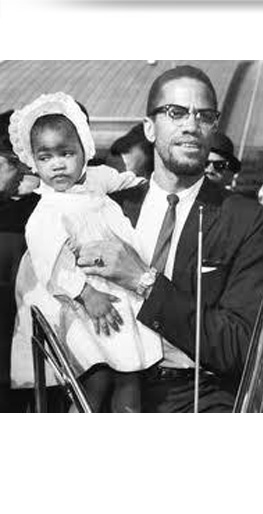
Proud, tall and regal like her father, with a radiant smile and
sincere eyes that resemble those of her mother, Ilyasah Al-Shabazz,
the third of Malcolm X and Dr. Betty Shabazz’s six daughters, is
an extraordinary leader in her own right. To his admirers, Ilyasah’s
father, Malcolm X or El-Hajj Malik El-Shabazz, was a prominent figure
in the Nation of Islam who articulated concepts of race pride and
Black Nationalism until the time of his death in 1965. Malcolm X
was known by many as the man who revolutionized the black psyche,
becoming one of the greatest and most influential African Americans
in history. To Ilyasah, he was known simply as “Daddy.”
Shabazz’s presence fills the room the moment she enters. Her presence,
however, is eclipsed only by her intellect and her desire for people
of color to know themselves and understand their history, and for
the world to understand the significant contribution of Africa and
the Diaspora. While Shabazz, who reads and writes Arabic, continues
in her parents’ immense footsteps, she in no way stands in their
shadows. She is an accomplished author, motivational speaker and
producer who has traversed the United States and the world over
to promote peace and to advocate for human rights and social justice.
Shabazz is trustee for the Malcolm X Foundation and the Malcolm
X and Dr. Betty Shabazz Memorial and Educational Center, Inc.
The brilliant woman who earned a Bachelor’s degree in biology from
State University of New York and a Master’s degree in education
and human resource development from Fordham University did not get
the chance to grow up in the protective arms or under the watchful
eye of her father. Shabazz’s understanding of her father, a public
figure that loomed larger than life on the world stage of international
human rights and American civil rights, came directly from her mother
who very privately preserved his legacy as a proud father and family
man. It wasn’t until Shabazz went to college that she began to fully
grasp the magnitude of her father’s public persona and develop her
own identity as the daughter of Malcolm X.
Malcolm X, as a husband and father, was very sentimental, especially
when it came to his “Apple Brown Betty,” as he adoringly called
his wife. He loved her beautiful brown skin and wrote for her poetry.
Malcolm appreciated beauty in the little things that made his life
with Betty special. Theirs was a loving, old-fashioned relationship
where he would leave money for his wife so she could go shopping
to buy some of the things she loved. The Muslim leader and charismatic
speaker loved his wife for her wit, self-reliance, compassion and
loyalty. He appreciated that she understood how difficult the break
from the Nation of Islam was for him in 1964.
After Malcolm’s death, Betty received an outpouring of love and
support from her relatives, celebrity friends including Sidney and
Juanita Poitier; Ossie Davis and Ruby Dee; and a host of people
who cared for Malcolm and their young family. Betty made raising
the girls her single most important mission and although she was
left exhausted caring for the physical, emotional and financial
needs of six children, Betty never, ever gave up or gave in. Ilyasah
and her sisters were never made to feel that were raised in a single-family
household because their mother kept their father’s spirit and message
very much alive in their home. After his death, Malcolm X’s personal
belongings were always present in their home—his briefcase, coat,
hat, many of his papers and his books were there for his daughters
to see and touch. At dinnertime when the girls would sit around
the family table talking about the day’s events, Betty would speak
lovingly of their father. She would talk about their shared values
and lessons that he would have passed on to his daughters. “Daddy
wouldn’t agree with that, he would do it this way, or Daddy said
this,” Betty would say.
In her wonderful memoir, Growing Up X, and whenever she speaks in
a public forum, Shabazz describes her dad as compassionate, fair,
gentle, loving, humorous, very sensitive, and an extraordinary problem
solver. “The public image of Malcolm was always seen from the perspective
of someone reacting to the social climate that already existed.
To contribute all of your life’s work to addressing the injustices
of a nation really says a lot about a person,” Ilyasah says. “It
says something about one’s integrity, compassion and commitment.
It wasn’t like he was doing these things to make money. He was doing
these things out of sheer concern for the world, and black people
in particular.” To truly carry on her father’s legacy, Shabazz believes
that it starts with understanding that we can’t expect other people
to do for us what we have the power to do for ourselves, and if
we understood history we would know that nobody is going to give
us anything. “My mother and my father are both such inspirations
to me. They influenced how I live my life today and always,” Ilyasah
says.
«back to NEW BOOK
|