| |
Although it may be hard for some to believe, cultural icon Russell
Simmons didn’t arrive at this staggering level of success and affluence
on his own. He didn’t just wake up one morning as one of the most
innovative and influential figures in modern American business and
culture. With the roll of the dice, he didn’t just turn into an
international human rights advocate, champion of the Occupy Wall
Street Movement, and stalwart animal rights activist. Quite the
contrary, he absorbed the good and the bad from his surroundings.
He strategized, planned, and meditated. Simmons created a vision
and a path to enlightenment that fueled his staggering success.
His undeniable sense of self came from watching, listening to and
learning from his father, Daniel Simmons Sr. Russell Simmons’s tireless
advocacy in strengthening race relations and promoting tolerance
and understanding is an enduring testament to his father.
Simmons has been the authority in bringing the powerful influence
of hip-hop culture to every facet of business, media, and fashion.
The master entrepreneur, with an estimated net worth of $340 million,
has been in the business of creating an entirely new, post-racial,
progressive new America. Simmons’s business success has always been
rooted in giving a powerful voice to emergent new creative and social
movements, and integrating them into the American psyche. His father’s
wisdom is at the core of all that he has achieved.
His father grew up in Baltimore, Maryland. From the time he was
old enough to engage in real dialogue with his father about life
and manhood, he and his dad talked at great length about the elder
Simmons’s upbringing and how tough it was growing up on the crime-laden
streets of Baltimore. Daniel Sr. told his son stories of how he
wouldn’t back down, refused to do what the “cool” people did and
was never, ever a follower. “He wasn’t a punk and he was always
tougher than everybody because he did what he wanted to do,” Russell
says.
Simmons draws parallels between his father’s life and the life of
a rapper. He recalls that like rap artists, his father wrote and
recited poetry that may have been offensive to a lot of the upper-class,
black bourgeoisie. Above all else, Simmons’s father inspired each
of his sons by being connected to the streets and the suffering
of black people in America. Simmons speaks poignantly about his
father, juxtaposing his connection to the streets with a sense of
culture that allowed him to exist between two worlds. Simmons thinks
about the poetry and the art that his father cared about and notes
that his father prided himself in embracing the hood without being
consumed by it. He went on to explain that his dad did not respect
black men who go along with what’s not threatening. He deplored
the idea of living to simply exist. He remembers his father, who
passed away in 2006, as a revolutionary. As such, Simmons spent
years cultivating his own sense of self, taking social and cultural
cues from his father and paying homage to the legacy Daniel Sr.
left behind.
Simmons credits his father as the person who shaped his views in
terms of seeing the world through the lens of true individualism
and making choices in his life that were not conventional. “Do you.
Don’t be a follower. Don't be a sheep,” Russell says, remembering
what he learned from his father. Simmons argues that most young
people do a lot of things just to be cool. In fact, in his first
attempt to become a successful entrepreneur, he sold marijuana and
later, fake cocaine, which he made from crushing up coca leaf incense.
In his book, Super Rich, he wrote, “I responded to the low notes
that were playing around me with some of the things that I did earlier
in my life.” Admittedly, he fell prey to the trappings of society,
trying to wear certain clothes and do things others did. But while
Simmons had his share of missteps, he kept his eye on the “cool
dudes” on his block—the educated ones. He saw educated black men
as inspirational. Like his father, they motivated him to succeed
and let him know that if he worked hard and created a roadmap for
himself, he could one day have a life that far exceeded his own
expectations.
Neither his father nor his mother was much in the way of being strict
disciplinarians. However, when Simmons or his brothers did something
their father didn’t like, “he whipped that ass,” Russell admits.
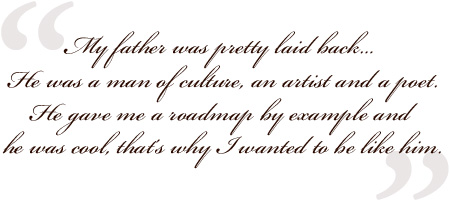
Approval from his dad was a pat on the shoulder. Simmons remembers
his dad being pretty laid back throughout much of his childhood.
He provided all three of his sons a roadmap by example and, Simmons
will never forget that his father was a trendsetter. “My father
was cool, and that’s why I wanted to be like him. He’d have a funky
hat. I would rock his hat. My father was more connected to me in
a friendly way more than a disciplinarian, angry way. He would lead
me rather than dictate,” Russell reflects.
«back to NEW BOOK
|