| |
When true basketball enthusiasts speak of Allan Houston, the label
pure shooter typically spills from their lips as they pay homage
to the two-time NBA All-Star’s phenomenal shooting game. Some of
today’s NBA greats might argue that their baseline turnaround jumper
is better than Houston’s, but very few can prove it. With unrivaled
focus and dedication, he brought an extraordinary work ethic to
his venerable twelve-year NBA career, finishing as one of the league’s
all-time greatest long-range shooters and one of the all-time leading
scorers in Knicks history. As a preeminent figure in basketball,
he demonstrated a sense of maturity and selflessness that eludes
many players. He was recognized for four straight years as one of
The Sporting News’ “Good Guys in Sports” and helped Team USA bring
home the gold medal in the 2000 Summer Olympic games in Sydney,
Australia. But for all of his on the court success, Houston’s extraordinary
work off the court makes him a distinguished figure in the civic
and philanthropic communities.
Houston, now forty-two, is in the second phase of his basketball
career as the New York Knicks' assistant general manager. He is
also principal and co-founder of the Allan Houston Legacy Foundation,
a non-profit entity with year-round programming that focuses on
family, mentoring, and relationship building between fathers and
their children. Houston was named father of the year by the National
Fatherhood Initiative in 2007. In 2011 he received the President’s
Council on Service and Civic Engagement Award from President Barack
Obama’s administration.
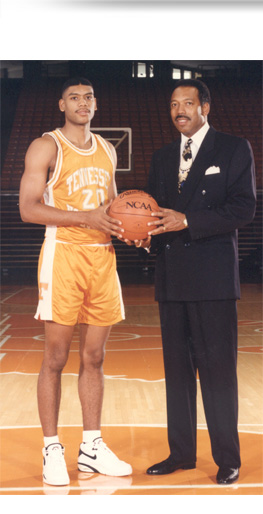
Houston is especially proud to have his father and mentor, Allan
Wade Houston, Sr., by his side as a member of the Allan Houston
Legacy Foundation management team and his de facto wingman. Houston’s
father has fueled his love for basketball and his desire to succeed
since he first picked up a basketball at age six. He draws from
the life lessons his father taught him and looks to his father for
advice on how to make the greatest impact in the lives of countless
families. To understand where Houston’s extraordinary sense of integrity,
exemplary values and overall greatness comes from, one only needs
to peer into the window of his father’s life to witness an undeniable
legacy of leadership.
In the midst of building a tremendous legacy as a college coach,
Wade never lost sight of his most important job—being a husband
and father. To this day, Houston cherishes the times with his dad
growing up. He recalls sitting on the couch when he was a young
kid watching boxing while his dad cut his hair. His also remembers
that his father wasn’t afraid to give him a hug, show affection,
and tell him, I love you. These experiences with his father fueled
Houston’s confidence and taught him that he had to look no further
than his own family to feel loved and supported. “He's very humble
man who doesn't have to say a lot, but whatever he said, it's like
gold because he backs it up with his actions,” Allan says.
As a standout high school player, Houston had his sights set on
playing college basketball for his father. During his senior year,
Houston signed a commitment letter to the University of Louisville
where his dad was assistant coach. He was thrilled to have a chance
to fulfill his dream of playing college ball for his father, but
in a twist of fate, months later Coach Houston was named head coach
of the University of Tennessee’s basketball program, making him
the first black head coach in the Southeastern Conference (SEC).
To see Wade face blatant discrimination when hostile crowds yelled
racial slurs was a difficult lesson for Houston, but it taught him
a great deal about his father’s character. Going to small southern
towns where bigotry loomed large and playing in front of racist
fans was difficult for him not only as a player but also as the
son of the head coach. “Just going to Starkville, Mississippi and
sensing the tension and hearing stuff about my dad was tough, but
it fueled me a lot too,” Allan says. “I combated this negativity
by turning my level up a little bit because I wanted him to succeed.”
Houston admits, however, that he wasn’t mature enough spiritually
or emotionally to forgive and get past it. He held on to a lot of
anger during his time as a University of Tennessee Volunteer, but
he knew he had to put his anger aside and get the job done on the
court.
During Houston’s sophomore year in 1991, the Volunteers played extremely
well in the SEC tournament and made it to the championship game.
At the end of one of those memorable games, Houston went up and
hugged his dad. This moment stands out for him because it summarized
everything they had gone through that season—all of the hardships
as well as the sanguine moments. “I just remember that embrace being
real cool because we won the game and games in the tournament when
we weren’t expected to,” Allan reflects. “I never felt closer to
my father.”
«back to NEW BOOK
|